

Blog
The “2+1” Standard: Why Our 3-Layer Spray Painting Process Ensures Premium Quality for Wood Products

Introduction
In the world of B2B wood manufacturing, the difference between a “cheap sample” and a “premium product” often lies less in the wood species and more in the wood finishing process.
Many factories cut corners by using a “1 Primer + 1 Topcoat” method to save 20% on material costs. The result? Products that look dull, feel rough, and yellow over time.
At Cabira Wood Supply, we adhere to the strict “2 Primer + 1 Topcoat” (2底1面) protocol. In this technical guide, we break down the specific values, thickness standards, and gloss levels we use to guarantee your orders arrive with a flawless finish.
The “2+1” Wood Finishing Process: Step-by-Step Breakdown
A perfect finish isn’t just about paint; it’s about the foundation. Here is our standard operating procedure (SOP):
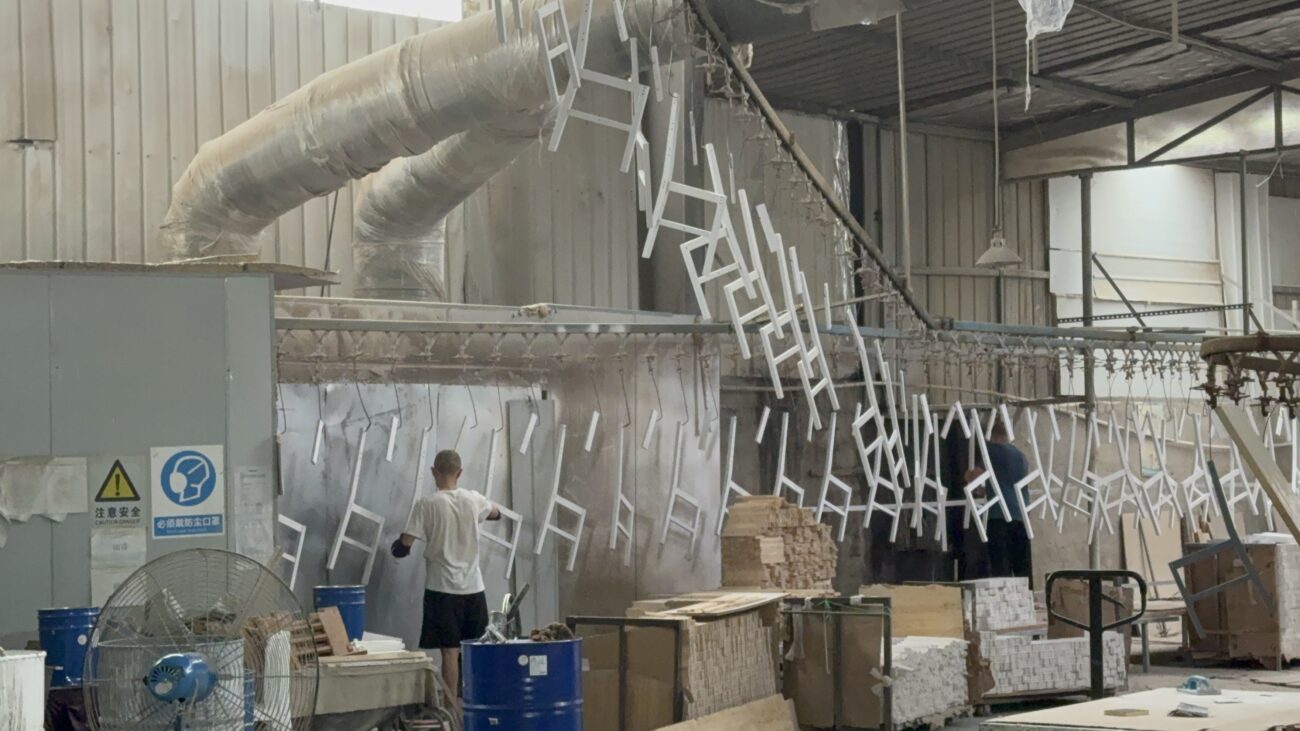
1. Surface Preparation (The Foundation)
Before a drop of paint touches the wood, we sand the raw timber.
- Abrasive Standard: We start with 180-grit sandpaper to level the surface and finish with 240-grit to smooth the wood fibers.
- Moisture Check: Wood must be at 8-12% MC (Moisture Content) to prevent the paint from bubbling later.
2. First Coat: Primer #1 (Sealing)
The first layer of primer penetrates the wood pores.
- Purpose: To create a bond with the wood fibers and seal the grain.
- Thickness: Wet film thickness of 100-120 microns.
3. Second Coat: Primer #2 (Building)
After the first coat dries and is sanded (using 320-grit sandpaper), we apply the second primer.
- Purpose: To build the “body” of the finish, hiding minor imperfections and creating a perfectly flat surface.
- Viscosity: Controlled at 18-22 seconds (Ford Cup #4) to ensure no running or sagging.
4. The Final Coat: The Topcoat (Protection)
This is the “face” of the product. We apply a premium PU (Polyurethane) or NC (Nitrocellulose) lacquer.
- Purpose: Scratch resistance, water resistance, and gloss control.
- Total Dry Film Thickness: The final combined thickness of our 3-layer system reaches 60-80 microns, compared to the industry average of 40 microns.
When you order “Matte” or “Glossy,” what does that actually mean? We measure sheen using a 60° Gloss Meter to ensure consistency across batches.
Use this chart to specify your orders with us:
| Finish Type | Gloss Unit (GU) at 60° | Best Used For |
| Dead Matte (全哑) | 0 – 5 GU | Rustic, “Raw Wood” look, Japandi style furniture. |
| Matte (哑光) | 10 – 15 GU | Modern minimalist designs. Hides fingerprints well. |
| Satin / Eggshell (半哑/丝光) | 30 – 45 GU | The Industry Standard. Most common for dining tables and chairs. Warm & elegant. |
| Semi-Gloss (半高光) | 50 – 70 GU | Traditional furniture. Highlights the wood grain depth. |
| High Gloss (高光) | > 85 GU | Luxury lacquer boxes, piano finishes. Highly reflective. |
Pro Tip: For most B2B export orders (Amazon/Retail), we recommend Satin (30-45 GU). It offers the best balance between aesthetics and scratch concealment.
Why the “2+1” Method Matters for Your Business
Why do we spend the extra time and money on two coats of primer?
- Prevents “Orange Peel” Effect: The double primer fills the wood grain completely, ensuring the topcoat lies flat like a mirror, rather than bumpy like an orange skin.
- Color Consistency: For products like our White Montessori Cube Chairs, double priming ensures the natural wood color doesn’t “bleed” through, keeping the white pure and bright.
- Durability: A thicker film thickness (80 microns) means the product can withstand daily wear and tear without the paint chipping off.
Conclusion
Quality control is in the details—the microns of thickness, the grit of the sandpaper, and the viscosity of the paint. At Cabira Wood Supply, we don’t just “paint” wood; we engineer a finish that protects your brand’s reputation.
Looking for a manufacturer who understands strict wood finishing process standards?
👉 [Contact Cabira Wood Supply for a Quote and Paint Sample Board]
 Furniture